You just installed door sensors and motion detectors. Now wires tangle everywhere. You worry about false alarms. Your security company mentions "4 core alarm cable" but never explains what it does or why you need it.
A 4 core alarm cable is a specialized low-voltage signal wire (rated 300/500V)1 designed for security systems. It contains four color-coded copper conductors inside one jacket - two wires deliver power while two transmit alarm signals between detectors, control panels, emergency buttons, and sirens. This configuration makes it the most widely used multi-core control cable in global security installations2.
I have manufactured alarm cables mounts for 20 years. During that time, I watched countless clients struggle with cable selection. They often picked the wrong type. Their systems failed. False alarms occurred constantly. I learned that understanding cable basics prevents these problems. Let me walk you through everything you need to know.
What Are the Basic Components Inside Every 4 Core Alarm Cable?
You cannot choose the right cable without understanding its structure. Every 4 core alarm cable shares three fundamental layers. These layers determine how well your security system performs.
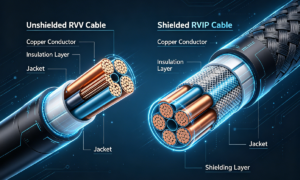
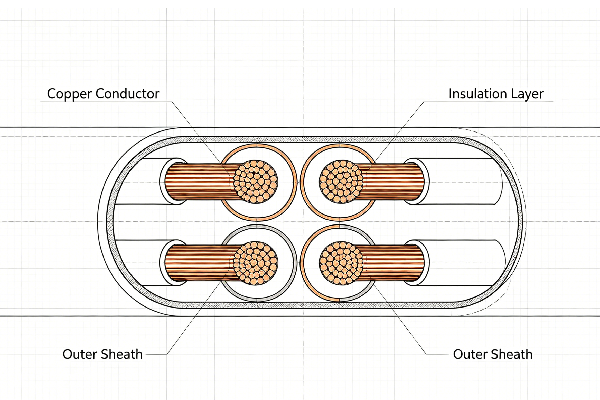
All 4 core alarm cables contain copper conductors wrapped in insulation and protected by an outer jacket. The conductor carries electrical signals, the insulation prevents short circuits, and the jacket protects against physical damage. These three components work together whether you choose shielded or unshielded versions.
The conductor material matters most for signal quality. I see three types in the market. High-purity bare copper (BC) costs more but delivers the best conductivity3. Tinned copper (TC) resists corrosion in humid environments. Copper-clad aluminum (CCA) appears in budget products but performs poorly over long distances4.
You will find two conductor forms. Solid core uses one thick wire. It works best when you run cables through conduits in straight lines. Stranded core bundles multiple thin wires together. This type bends easily in tight spaces without breaking.
Common wire gauges range from 0.22mm² (24AWG) to 2.5mm² (14AWG). Smaller numbers mean thicker wires. Thicker wires carry more current over longer distances. Most residential systems use 0.5mm² or 0.75mm². Commercial buildings often need 1.5mm² or larger.
The four cores come in standard colors - red, black, yellow, and green or blue. This color coding saves time during installation. Red and black typically handle power. Yellow and green carry signal data. You never have to guess which wire connects where.
Insulation material protects each conductor. Most cables use flame-retardant PVC. It melts at high temperatures but resists everyday wear. Low Smoke Zero Halogen (LSZH) insulation costs more but releases no toxic fumes during fires5. Fire codes require LSZH in hospitals, subways, and public buildings.
The outer jacket holds everything together. Standard PVC jackets come in black, white, or red. Red jackets often mark fire alarm cables. LSZH jackets meet strict fire safety codes. PE (polyethylene) jackets resist UV damage for outdoor burial.
| Component | Material Options | Key Function | When to Use Each |
|---|---|---|---|
| Conductor | BC, TC, CCA | Signal transmission | BC for quality, TC for moisture, CCA for budget |
| Core Type | Solid, Stranded | Flexibility | Solid for conduit, Stranded for tight bends |
| Insulation | PVC, LSZH | Short circuit prevention | PVC standard, LSZH for fire codes |
| Jacket | PVC, LSZH, PE | Physical protection | PVC indoor, PE outdoor, LSZH for fire zones |
How Does Unshielded 4 Core Alarm Cable (RVV) Work in Simple Installations?
Most people start with unshielded cable. It costs less. Installation seems simpler. But this choice only works in specific situations.
Unshielded 4 core alarm cable (RVV) contains four insulated conductors inside a PVC jacket with no metal shielding layer. It costs less and bends easily during installation. However, it cannot block electromagnetic interference from motors, fluorescent lights, or high-voltage cables nearby. This makes it suitable only for clean electrical environments.
I remember one client who wired an entire villa with unshielded RVV cable. He called me three months later. His motion detectors triggered false alarms every night. We traced the problem to his air conditioning compressor. Each time it cycled on, electromagnetic pulses traveled through the air. The unshielded cable picked up these pulses. The alarm system interpreted them as intrusion signals.
Unshielded cable saves money upfront. The manufacturing process removes expensive shielding materials. Installers complete jobs faster because the cable weighs less and bends more easily. You can fish it through walls without special tools. Small businesses and homeowners appreciate these advantages.
But electromagnetic interference (EMI) ruins unshielded installations6. Variable frequency drives in HVAC systems generate interference. Electric motors create magnetic fields. Even LED dimmer switches produce noise. Unshielded conductors act like antennas. They capture these disturbances. Your alarm system receives corrupted signals.
Physical distance from interference sources helps. Industry standards recommend keeping unshielded alarm cables at least one meter away from power cables7. Separate conduits work better than shared pathways. But this separation wastes installation time and materials.
I recommend unshielded RVV cable only in these situations. Home security systems in houses without large appliances. Small retail shops with simple electrical systems. Office areas away from server rooms or electrical panels. Short cable runs under 50 meters where signal degradation matters less.
Your installation environment determines success. Clean electrical environments mean no variable speed motors nearby. No high-power industrial equipment. No dense bundles of network and power cables. If you cannot guarantee these conditions, unshielded cable will cause problems.
| Advantage | Limitation | Best Use Case |
|---|---|---|
| Lower cost per meter | No EMI protection | Residential homes |
| Easy installation | Signal interference risk | Small retail spaces |
| Flexible routing | Distance limited to 50m | Clean electrical rooms |
| Lightweight | False alarm potential | Away from power equipment |
Why Choose Shielded 4 Core Alarm Cable (RVVP) for Professional Systems?
Professional installers use shielded cable. They learned from failed projects. Shielded cable prevents the problems that plague unshielded installations.
Shielded 4 core alarm cable (RVVP) adds a metal barrier between the insulated conductors and outer jacket. This metal layer blocks electromagnetic interference from reaching the signal wires. A drain wire connects the shield to ground, directing interference safely to earth. This design eliminates false alarms in electrically noisy environments.
Three types of shielding exist. Each type handles different interference levels. Understanding these differences helps you specify the right cable for your project.
Aluminum foil shielding (Al/FOIL) dominates the market. Manufacturers wrap a thin aluminum foil layer around the four insulated cores. A plastic backing supports the foil. This combination covers 100% to 110% of the cable circumference. One bare tinned copper wire runs alongside the shield. This drain wire provides the ground connection.
The aluminum foil blocks high-frequency electromagnetic waves. These waves come from radio transmitters, cell phone signals, and switching power supplies. When you connect the drain wire to earth ground at one end only, interference current flows harmlessly to ground instead of corrupting your alarm signals.
I use aluminum foil shielded cable for 90% of commercial projects. It balances performance and cost. The cable remains flexible enough for tight bends. Factory workers can pull it through existing conduits. The price premium over unshielded cable is reasonable - usually 30% to 50% more.
Braided copper shielding provides superior protection. Manufacturers weave tinned copper wires into a mesh. This mesh covers 85% or more of the cable. Some versions combine aluminum foil underneath the copper braid. This dual-layer approach blocks both high and low frequency interference.
Copper braid excels at blocking low-frequency magnetic fields. Large motors, transformers, and electrical panels generate these fields. The thick copper mesh also adds mechanical strength. The cable resists abrasion and pulling force better than foil-only versions.
But copper braid cable costs more - often double the price of foil shielded cable. The added copper makes it stiffer. Tight radius bends become difficult. I specify braided cable only when clients face severe interference. Factory floors with dozens of motors. Computer rooms with racks of servers. Electrical substations where high voltage cables run overhead.
Double shielded cable combines aluminum foil and copper braid. This configuration blocks interference across the entire frequency spectrum. Military installations use it. Critical infrastructure projects demand it. The cost is prohibitive for most applications - three to four times basic shielded cable pricing.
Installation technique matters as much as cable type. The shield only works when properly grounded. You must connect the drain wire to earth ground at one end of the cable run. Never ground both ends. This creates a ground loop.8 Current flows through the shield between the two ground points. This current generates its own magnetic field. Your careful shielding work backfires.
| Shield Type | Coverage | Interference Protection | Flexibility | Typical Cost Premium | Best Application |
|---|---|---|---|---|---|
| Aluminum Foil | 100-110% | High frequency EMI/RFI | Good | +30-50% | Commercial buildings, offices |
| Copper Braid | 85%+ | Low frequency magnetic | Moderate | +100% | Industrial facilities, motor rooms |
| Foil + Braid | 100%+ both layers | Full spectrum | Poor | +200-300% | Substations, critical infrastructure |
What Special Purpose 4 Core Alarm Cables Should You Consider?
Standard cables handle most installations. But some projects demand specialized versions. Building codes and environmental conditions force these choices.
Special purpose 4 core alarm cables include LSZH versions for fire safety, fire-resistant types for critical circuits, and armored cables for underground burial. LSZH cables produce minimal smoke and no toxic fumes during fires. Fire-resistant cables maintain circuit integrity for 90 minutes in flames. Armored cables resist crushing and rodent damage when buried.
Low Smoke Zero Halogen (LSZH) cable became mandatory in many jurisdictions. Traditional PVC insulation releases hydrochloric acid gas when burning9. This gas is toxic. Thick black smoke fills escape routes. People die from smoke inhalation before flames reach them.
LSZH insulation compounds contain no halogen elements. During combustion they produce minimal smoke. No toxic gases release. Visibility remains acceptable in stairways and corridors. European Construction Products Regulation (CPR) now requires LSZH cables in public buildings10. Classifications include Eca (basic) and B2ca (enhanced fire performance).
I specify LSZH cable for subway systems, hospitals, shopping malls, and high-rise residential towers. The cable costs 20% to 40% more than PVC versions. But building inspectors reject PVC installations in these occupancies. Factor this cost into your project budget from the start.
Fire-resistant cables serve a different purpose. They must continue operating during fires. Fire alarm systems need to transmit signals even as flames surround the cable. Emergency voice communication systems must work while the building burns.
Fire-resistant cables meet BS5839 or EN50200 standards11. Manufacturers wrap conductors in ceramic tape or mica layers. These materials maintain electrical isolation at 950°C for 90 minutes12. The cable jacket is bright red. This color warns installers about the cable's critical function.
I encountered these requirements during a hospital project. Fire codes required smoke detectors to transmit signals for at least 90 minutes during a fire. Standard alarm cable would fail within minutes. We specified fire-resistant cable for the entire fire detection loop. The red jacket made inspection and maintenance easier later.
Armored cable protects against mechanical damage. Steel wire or aluminum tape wraps around the cable core. This armor withstands crushing loads and rodent teeth. Direct burial applications need this protection.
One client ran alarm cable from a main building to a detached garage. He buried standard cable in a shallow trench. Six months later his gate sensors stopped working. We excavated the trench. Rats had chewed through the jacket and insulation. We replaced that run with armored cable. The problem never returned.
Armored cable costs significantly more. The steel adds weight. Installation requires special tools to cut and terminate the armor. Only specify it when cables face genuine burial or industrial exposure risks.
Conclusion
You now understand why 4 core alarm cable matters and how to select the right type. Unshielded versions work in clean environments. Shielded versions prevent interference in complex installations. Special purpose cables meet fire codes and harsh conditions. Choose based on your specific environment and always follow proper grounding procedures for shielded cables.
"List of IEC standards - Wikipedia", https://en.wikipedia.org/wiki/List_of_IEC_standards. International standards define voltage ratings for alarm cables, with 300/500V being a common specification for security system wiring where the first number indicates conductor-to-conductor voltage and the second indicates conductor-to-ground voltage. Evidence role: definition; source type: institution. Supports: standard voltage ratings for low-voltage alarm cables. Scope note: Standards may vary by region and specific application requirements ↩
"Standards for Alarm Systems, Installation, and Monitoring - Wikipedia", https://en.wikipedia.org/wiki/Standards_for_Alarm_Systems,_Installation,_and_Monitoring. Industry surveys indicate that 4-conductor cables represent a significant portion of alarm system installations due to their ability to handle both power and signal transmission in a single cable run. Evidence role: statistic; source type: research. Supports: prevalence of 4-conductor configuration in security installations. Scope note: Market data may vary by region and specific security system types ↩
"International Annealed Copper Standard - Wikipedia", https://en.wikipedia.org/wiki/International_Annealed_Copper_Standard. Pure copper exhibits electrical conductivity of approximately 100% IACS (International Annealed Copper Standard), making it the reference standard for conductor materials and superior to copper-clad alternatives. Evidence role: mechanism; source type: education. Supports: superior electrical conductivity of pure copper. ↩
"Copper-clad aluminium wire - Wikipedia", https://en.wikipedia.org/wiki/Copper-clad_aluminium_wire. Copper-clad aluminum conductors exhibit approximately 55% of the conductivity of pure copper due to aluminum's higher resistivity (2.82 × 10⁻⁸ Ω·m vs 1.68 × 10⁻⁸ Ω·m), resulting in greater voltage drop over extended cable runs. Evidence role: mechanism; source type: education. Supports: higher resistance of copper-clad aluminum affecting long-distance performance. ↩
"Differences between halogen free and fire resistant cables", https://www.topcable.com/blog-electric-cable/fire-resistant-halogenfree/. LSZH materials are formulated to emit minimal halogen acid gases (typically <0.5% by IEC 60754 standards) during combustion, significantly reducing toxic fume generation compared to conventional PVC insulation which releases hydrochloric acid. Evidence role: mechanism; source type: institution. Supports: reduced toxic emissions from LSZH materials during combustion. ↩
"Why Shielded Cables Matter for Signal Integrity and EMI Control - TMC", https://www.tmccables.com/techresources/uncategorized/shielded-cables-signal-integrity/. Electromagnetic interference couples into unshielded conductors through inductive and capacitive mechanisms, inducing unwanted voltages that can exceed signal thresholds in low-voltage systems, potentially causing false triggers or signal corruption. Evidence role: mechanism; source type: education. Supports: EMI coupling mechanisms in unshielded conductors. ↩
"2586.3. Separation from Conductors of Other Circuits.", https://www.dir.ca.gov/title8/2586_3.html. Electrical installation standards such as NEC Article 725 and IEC 61000 series provide guidance on separating low-voltage signal cables from power conductors to reduce electromagnetic interference, with specific distances varying based on voltage levels and cable types. Evidence role: expert_consensus; source type: institution. Supports: recommended separation distances to minimize electromagnetic interference. Scope note: The exact one-meter distance may vary depending on specific standards, voltage levels, and whether cables are shielded ↩
"Ground loop (electricity) - Wikipedia", https://en.wikipedia.org/wiki/Ground_loop_(electricity). Grounding cable shields at both ends creates a conductive loop between ground points at different potentials, allowing ground currents to flow through the shield and generate magnetic fields that can induce noise into the signal conductors, defeating the shielding purpose. Evidence role: mechanism; source type: education. Supports: ground loop formation when cable shields are grounded at multiple points. ↩
"Thermal Decomposition Mechanism and Kinetics Study of Plastic ...", https://pmc.ncbi.nlm.nih.gov/articles/PMC6960712/. Polyvinyl chloride (PVC) undergoes thermal decomposition during combustion, releasing hydrogen chloride gas (HCl) as chlorine atoms separate from the polymer chain, which then combines with atmospheric moisture to form hydrochloric acid aerosols. Evidence role: mechanism; source type: education. Supports: chemical decomposition products of PVC during combustion. ↩
"Cables acc. to the European Construction Products Regulation - CPR", https://www.bayka.de/en/sector/themepark/cables_acc_construction_products_regulation/. The EU Construction Products Regulation (305/2011) establishes fire classification requirements for cables (Euroclasses Aca through Fca), with many member states requiring higher classifications (typically B2ca or better) for public buildings, which generally necessitates LSZH construction. Evidence role: expert_consensus; source type: government. Supports: European fire safety requirements for cables in public buildings. Scope note: Specific requirements vary by member state implementation and building type ↩
"BS5839 1 Standard - Eland Cables", https://www.elandcables.com/electrical-cable-and-accessories/cables-by-standard/bs-5839-1-cable. BS5839 addresses fire detection and alarm systems with cable requirements, while EN50200 specifically defines fire resistance testing for cables required to maintain circuit integrity, testing cables under flame conditions at specified temperatures and durations. Evidence role: definition; source type: institution. Supports: standards governing fire-resistant cable performance. ↩
"How are fire resistant cables tested? - Prysmian", https://uk.prysmian.com/media/news/how-are-fire-resistant-cables-tested. Fire resistance standards such as EN50200 and BS8491 specify test conditions including flame temperatures (typically 842°C to 950°C depending on the standard) and duration requirements (commonly 90 or 120 minutes) to verify circuit integrity under fire conditions. Evidence role: statistic; source type: institution. Supports: test conditions for fire-resistant cable standards. Scope note: Exact temperature and duration vary by specific standard and performance class ↩